
Variability is key (warmups)
In this series, I am detailing the goal of our summer: train like cats to become more like cats—built on the pillars of functional variability and a quick central nervous system (CNS). Welcome to part two. In this post, I want to dive into how we applied those ideas, starting with warmups.
Dynamic Warmups
If functional variability is the goal, then warmups should be designed to prepare for it—getting athletes ready to find and execute movement solutions safely and effectively. A traditional warmup might raise body temperature, but it doesn’t prepare an athlete for the unpredictable variability of the game.
Instead, we followed Fergus Connolly’s framework for a quality warmup:
- Warm up the body (through activity)
- Warm up the mind (through decisions)
- Warm up the muscles (through movement)
The first unique and intentional decision we made was to warm up, sprint, and jump outside on the grass without shoes as much as possible. This had multiple benefits:
- CNS activation and proprioception: Without shoes, the nerve endings on the bottom of the foot deliver richer, quicker feedback to the brain. That faster communication sharpens coordination, speeds up reactions, and boosts balance and agility. This also improves proprioception (or the body’s ability to sense its position and movement in space) which is critical for making quick, precise adjustments during play.
- Foot strength: Strengthens the small muscles and tendons in the feet, which are often underdeveloped from wearing shoes and traditional weight room training. Because the feet are the first point of contact in nearly every movement, strong feet can both create more force (higher performance) and absorb more force (more durability)—critical factors for athletes focused on sprinting and jumping all summer.
- Impact: Grass has less impact than hardwood, reducing stress on joints during warmups while still allowing for explosive movements.
- Mobility: Improves foot and ankle range of motion without the restrictions of a shoe, allowing athletes to move more freely and adapt to a wider variety of positions.
- Surface variability: Grass provides an uneven surface, adding a natural variability challenge to movement patterns. Its moderate give reduces impact while staying firm enough for athletes to execute sharp, powerful movements that adjust to the ground’s subtle changes. This constant adaptation makes the toes grip, the arches stabilize, and the ankles adjust—building control, stability, and resilience.
- Grounding: Direct contact with the ground may have restorative and recovery effects.
There were two parts to our warmups that eventually led to our speed or plyometric work (detailed in the next part of this series).
The first part: Mirror Drill Variations.
Every warmup started with some type of mirror drill. These check all three boxes—players are physically active, making quick decisions, and moving through game-relevant patterns and ranges of motion (where the options extend beyond the traditional way we think about movement). They’re also far more engaging than standard warmups, as players interact, laugh, and start practice with positive energy.
For the "offense," the goal is to get into as many unique movements and positions as possible, emphasizing variability and embracing the imperfect—like a squat with knees over the toes or lunges at varying depths. For the "defense," they must react as quickly as possible to the offensive player’s movement and mirror that movement as precisely as possible.
We modify mirror drill in many ways—changing where the defender is located in relation to his teammate, the primary movements performed (dynamic movements, jumping, or sprinting), the body positioning (on the ground or standing), the directional plane or type of landing players end their movements, and what’s done in between these movements (pulsing or walking). The goal is for it to look different every day. The stumbles, pauses, and awkward movements aren’t flaws in the warmup—they’re proof that it is doing its job. They show athletes actively problem-solving in real time, just as they’ll need to in practice and games.
The second part of our warmups: Small Space Games.
We then moved on to a competitive game to raise the intensity. Spikeball was a player favorite, but it also has many intrinsic warmup benefits—it forces athletes into unique positions in a small space, with quick changes of direction, short bursts, jumps, landings, lunges, and constant decision-making, communication, and interaction. The confined playing area naturally increases variability by making athletes solve problems in a smaller space with less time than other drills. And because the space is small, athletes can get quality movement work and a full-body warmup without going at full intensity, reducing the risk of early-session fatigue or injury. (Shoutout to the Dallas Mavericks for being big fans of Spikeball!)
Similar to Spikeball, my goal was to design games for plyometric days where players explored a variety of takeoff styles and landing solutions—while also getting the brain engaged through perception-based triggers for each jump. This meant jumping to different heights, in different directions, and reacting to cues rather than jumping in a predictable pattern.
While brainstorming ideas and exploring various playground games with Ben Falk, I came up with two small space games for plyometric days: Plyo Ball and Backboard Tennis. I’ll explain Backboard Tennis below.
Backboard Tennis Rules
- Order of Play: Players decide on an order before starting, and that order stays the same throughout the match.
- Gameplay: On their turn, a player must leave the ground and either tap or throw the ball off the backboard.
- Faults: A player misses a tip on their turn (the ball lands before they touch it), a player makes the shot, a player fails to hit the backboard, or a player's touch causes the ball to land outside the box (players can let the ball bounce to see where it lands—risking that if it lands inside the box, it’s their fault).
- Serving: Serve by throwing the ball off the backboard from outside the box, then join the order of play.
- Scoring: All players who do not fault in the round earn one point.
You can see that in this game, the variability of the environment is constantly at work, and players don’t have time to default to their preferred method of jumping and landing. Instead, they’re jumping off and landing on one foot and two, left foot and right, strong leg and weak...all while getting a concentrated burst of these varied repetitions in a short amount of time.
Remember in my first post of this series when I asked you to pause the tape of any NBA game to study the players’ body positions? Here’s the kind of thing you might see:
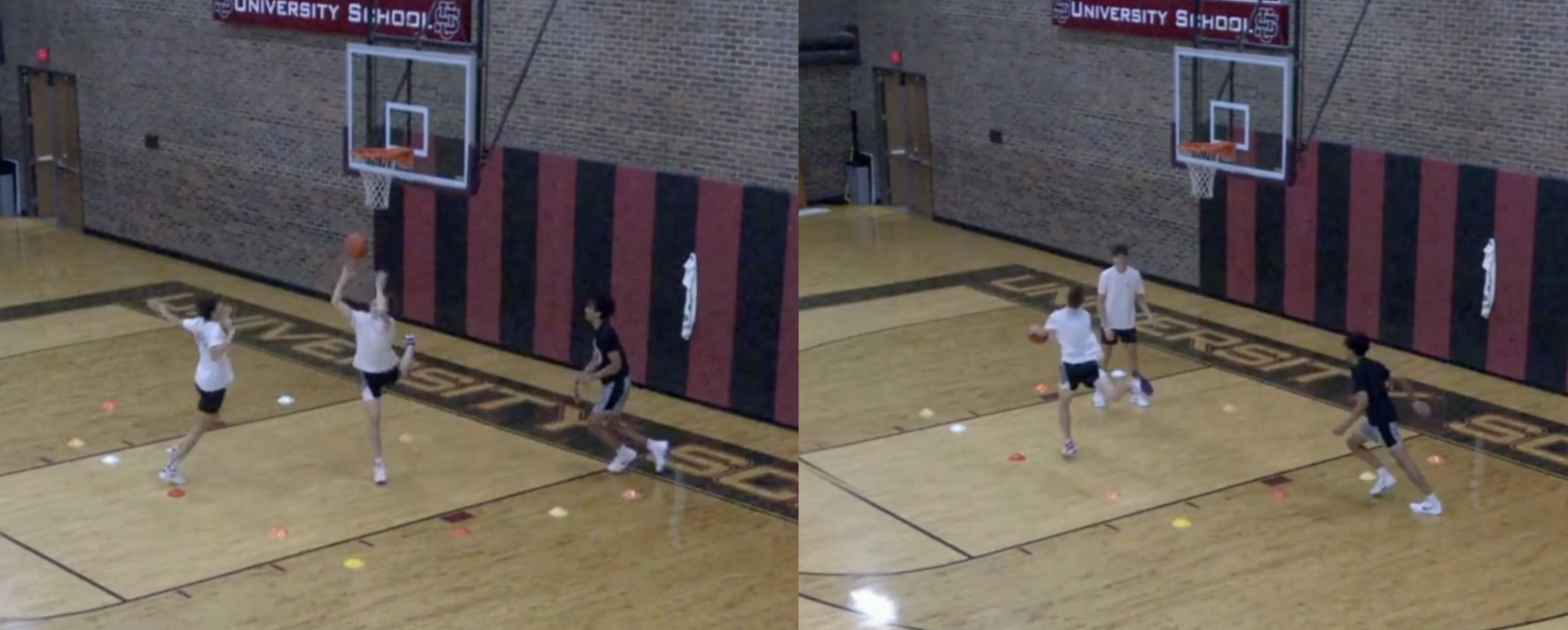
Once we did this, we were warmed up. We were ready to move on to full intensity in a larger setting.
PART ONE: Variability is key (an overview)
PART TWO: Variability is key (warmups)
PART THREE: Variability is key (sprinting, jumping, lifting)
PART FOUR: Variability is key (shooting)
PART FIVE: Variability is key (looking ahead)