
Great offense
For many years, I’ve been exploring how to design offenses where the whole is greater than the sum of its parts—where core offensive concepts amplify each player's abilities. Think about it: More space can make an average driver a good one...and a great driver an elite one. Easier, stationary shots can make an average shooter a good one...and a great shooter an elite one.
Many of the ideas below were inspired by Jimmy Tillette, and his appearance on The Basketball Podcast with Chris Oliver is a must-listen. It helped put into words ideas I hadn’t fully articulated—like how sequencing actions (rather than running them simultaneously) sharpens decision-making by narrowing the read and improving precision.
Offense can't just be "running plays." It’s the interplay between player movement, ball movement, and tactical actions that allow teams to create, attack, and sustain advantages. If these pieces are used in a cookie-cutter way or simply thrown together, they end up clashing. For example, actions can stall ball movement, and ball movement can interrupt the timing of actions. The two can only work in harmony with clear, intentional design.
With that in mind, I’ve broken offense into five core concepts—each linked to a desired effect when executed well. Within each bucket, I’ve included guiding questions you can use to evaluate your own approach to running offense.
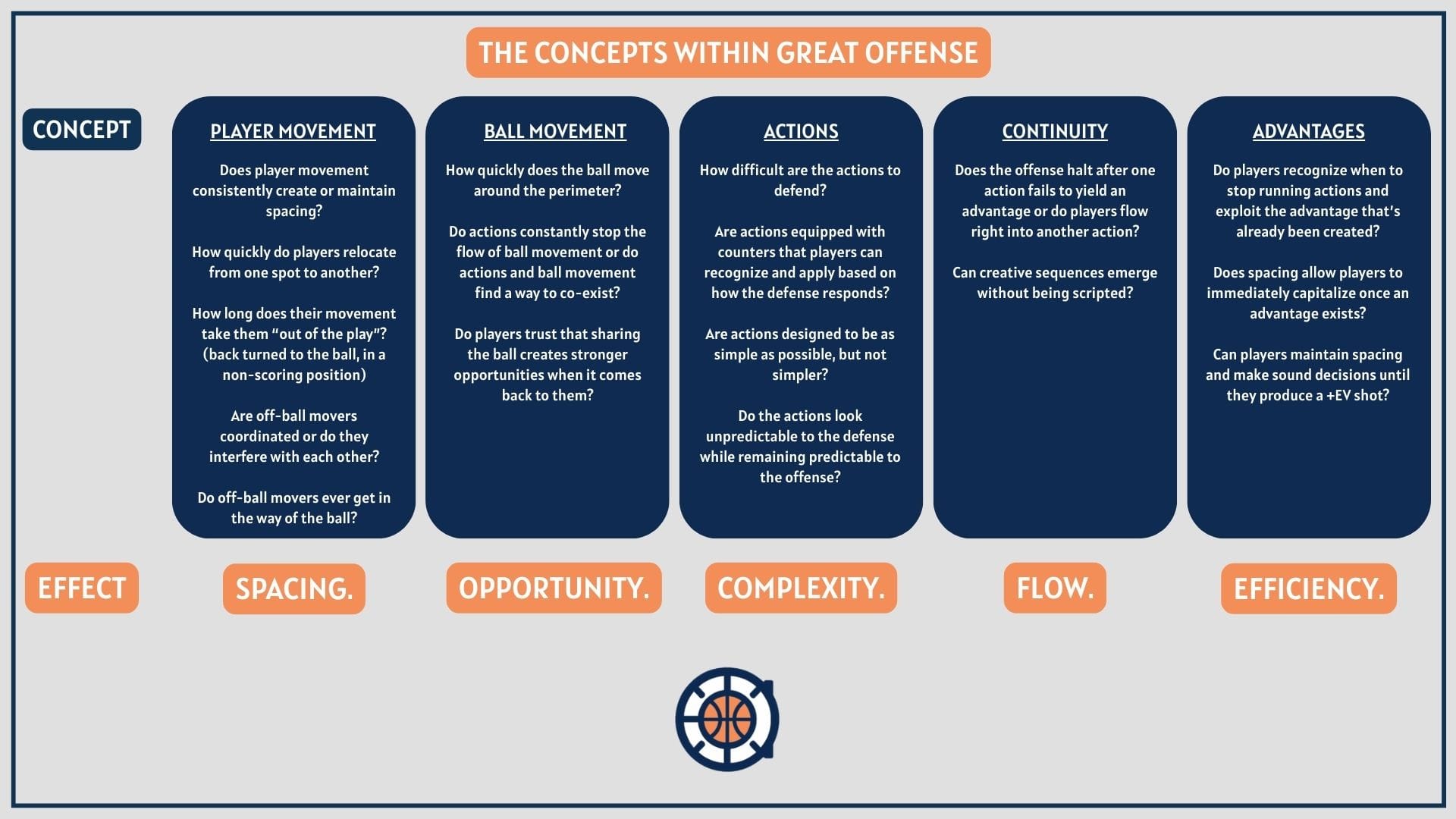
Stay tuned. In a future post, I'll share how we’ve worked to answer these questions within the concrete framework of our own offensive system.